
Neal D. Hulkower, PhD, is an applied mathematician, author, and freelance writer living in McMinnville, Oregon. While he has been writing regularly about wine-related topics since 2009, his first contributions to a wine publication appeared in Vintage in the early 1970s. His wine writing can be found in academic, trade, and popular publications including the Journal of Wine Research, the Journal of Wine Economics, American Wine Society Wine Journal, Oregon Wine Press, Practical Winery & Vineyard, Wine Press Northwest, The Grapevine, the Slow Wine Guide USA, and The World of Fine Wine and on wine-searcher.com, trinkmag.com, and guildsomm.com. Neal focuses on applications of mathematics to the world of wine, Willamette Valley wines, and reviews of wine-related books. He also enjoys covering wine events and personalities. He is a member of the American Wine Society, the American Association of Wine Economists, and the Circle of Wine Writers.
Previously, Neal was a senior executive at MCR and occupied three executive positions including President and CEO at RAF Technology. He also held positions of increasing responsibility at JPL, TRW, and MITRE. In addition, he taught mathematics at six colleges and universities. He can occasionally be found pouring some of Oregon’s finest in a tasting room at the top of the Dundee Hills.
Title by Neal D. Hulkower
Finally, the time has come. After embarking on a sideline gig as a freelance wine writer in 2011, I have accumulated enough pieces to more than fill a book. I was encouraged to do so by Don Saari, who had been my dissertation advisor at Northwestern and later became a fan of my more recent work.
This compilation has no single theme. Several have emerged, however, and serve as the titles of the parts. Since this is the work of a single author, elements one might expect in a memoir are present. My background as an applied mathematician also surfaces in several of the pieces. My initiation into the world of fine wine and the various vinous adventures I had over the years made for popular pieces that are included.
I started with the urtext and lightly edited the entries. I also added annotations and updates when necessary since in more ways than one, wine is a fluid subject. Several entries have not been published or posted anywhere before. The articles are organized into eight parts.
“In the Beginning” introduces my earliest wine writings and also includes an essay about my first interactions with German wines. Around the same time that I left full-time employment and immersed more fully into the wine world, I joined the American Association of Wine Economists (AAWE) since there is no equivalent for mathematicians. The annual meetings are held in wine regions around the world, giving me an excuse to travel to places I wouldn’t necessarily have visited, as well as providing a venue for sharing some of my research. Part II comprises my reports on these meetings.
As part of my deep immersion in wine, I expanded my reading on the subject. In addition to mostly online publications and other resources, I sought out books. In order to feed my habit and reduce costs, I began writing book reviews for two academic publications, the Journal of Wine Research and AAWE’s Journal of Wine Economics. If you are reading this (thank you!), you might search for some of the titles included in the third part.
I became a full-time resident of McMinnville, Oregon, the heart of the Willamette Valley, in July 2011. Three months later, my first piece appeared in the Oregon Wine Press (OWP). It has since proven to be receptive to many of my pitches. I include a few along with others that haven’t appeared elsewhere and one that did in Part IV. I
hope that they give a flavor of what life is like in this wonderful and burgeoning wine region. I have also met numerous wine personalities. Part V includes articles about four of them.
The Asociación Hispana de la Industria del Vino en Oregon y Comunidad (AHIVOY), the brainchild of Jesús Guillén, Sofía Torres McKay, and Miguel Lopez, holds a special place in my heart. At Jesús’s request, I first wrote about it when it was still an inchoate idea to pay forward to the vineyard stewards the good fortune the three had experienced. I continued to chronicle the realization of the idea and the early successes. When I was invited to join the board in 2022, I handed over the task of publicizing the happenings to another writer. Part VI chronicles the early years of the organization.
In 2019, I was recruited to become a field coordinator for the Slow Wine Guide USA, an offshoot of the Italian edition sponsored by the Slow Food movement. While the remuneration is meager—so much so that it almost qualifies as pro bono work—I continued to participate. I would be lying if I said that I didn’t take pleasure in going around and tasting remarkable juice. Some of the winemakers I visit each year have come to expect and enjoy our sessions, and the ones who I add appreciate the exposure. To add a bit of revenue and to publicize the guide, I published two reports in the OWP about the wineries I covered which constitute Part VII.
The book title is taken from an essay I published in the OWP on the fifth anniversary of the appearance of my first article in that monthly. I have since been successful in placing a range of pieces in other outlets as well. Part VIII, which also carries the name of the book, highlights some that I particularly like or that have especially
pleased my readers.
Several of the books I’ve reviewed contain a glossary at the end. Instead of producing yet another traditional one, I decided to take a cheekier approach. Let’s just say that the devil made me do it.
Feel free to jump around and sample the essays in whatever order you fancy. If they amuse, entertain, educate, encourage you to try a new bottle, or open a new book, I will have succeeded.
L’Chaim
Neal Hulkower
McMinnville, Oregon
February 2024
-
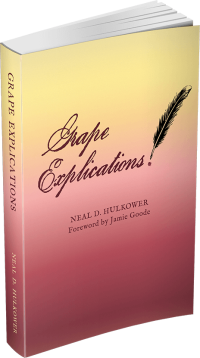
Entertaining, eclectic, and thought-provoking, Grape Explications reflects on the diversity of the wine world over time and across continents in a collection of articles and wine book reviews by an OG oenophile. Immerse yourself in Neal Hulkower’s quirky and sometimes controversial perspective on wine words, scores, spitting, and much more:
- Visit with wine personalities
- Meet globetrotting wine economists
- Take a quick look at Slow Wine
- Explore the burgeoning Willamette Valley with an insider
- Wine lovers, wine curious, and anyone who appreciates a good read will find something to savor.
Reviews
-
Simon Judge
Posted by
–
25 August 2025Neal Hulkower, author of Grape Explications, sent me his book to review. It is less a single, neatly packaged volume and more a glorious grab bag of articles, essays and musings. Think of it as a well-stocked cellar of words poured from his writing since the late 1970s.
Neal David Hulkower is a wine writer, reviewer and tasting room professional with decades of experience, all seasoned by an earlier life in academia, aerospace and the boardrooms of technology and operations. Since the late 1960s, he has been everywhere wine has needed him: pouring in Oregon tasting rooms, selling in shops, volunteering at marquee events, and scribbling about it all in journals, magazines and online. His output ranges from tasting notes and book reviews to economic dissections of the wine world, with his byline popping up in the Oregon Wine Press, Journal of Wine Economics, The World of Fine Wine, and beyond. The common thread? A mix of mathematical sharpness and genuine delight in what’s in the glass.
This book doesn’t so much march along a straight road as meander through eight themed parts: book reviews, the quirks of wine economists, and portraits of memorable personalities, to name a few. Jamie Goode nails it in the Foreword when he says Neal writes for the reader, not for the egos of people or wineries being featured.
Early on, the vintage tasting notes whisk us back to Neal’s first encounters with fine wine, capturing the thrill of discovery in careful sensory detail.
Then there’s the Borda point scoring system. It sounds dry, but Neal makes it fizz with life. A voting method dressed up as wine judging, it evens the playing field by giving every taster the same weight. No more one cranky judge wrecking the curve, Borda blends everyone’s rankings into a consensus that feels fair and democratic.
As an applied mathematician, Neal can’t resist poking holes in the numbers wine people cling to. He gleefully dismantles the Davis 20-point scale, skewers the tyranny of 100-point scores and shows why vintage charts are about as useful as yesterday’s weather report. His essays mix serious critique with a wink, turning what could be dry analysis into something refreshing and cheeky.
In the section Grape Explications, he admits he no longer keeps elaborate notes:
“Generally, I no longer keep detailed notes since formulating and recording them tends to distract me when I’m tasting. Enjoying wine, for me, is a wholly right-brained activity while writing exercises the other hemisphere.”
It’s hard not to nod along, I have been there, caught between savouring and scribbling.
The book reviews sparkle with his curiosity. His take on Eric Asimov’s How to Love Wine: A Memoir and Manifesto cheers Asimov’s plea to strip away intimidation and let wine be fun again. With Jamie Goode’s I Taste Red: The Science of Tasting Wine, Neal relishes the way science and sensory pleasure collide, giving us a bridge between neurons and nose.
Towards the end, Neal muses about spitting, equal parts etiquette lesson and comic relief, before puzzling over what we really mean when we call a wine ‘elegant’. And in one of the book’s more eyebrow-raising pieces, In Defense of Describing Wines as Masculine, Feminine, and Sexy, he looks into the linguistic thicket with boldness, arguing that these descriptors still have a place if handled thoughtfully and with respect.
In the end, Grape Explications is like sharing a long, winding tasting with a witty friend who knows his stuff but never takes himself too seriously. It’s smart without being stiff, playful without being flippant and full of both love for wine and gentle mischief. Readers will come away entertained, enlightened, and maybe even inspired to taste, and think, a little differently.
You can learn more and buy the book on Neal’s publisher web site.
-
Greg Norton
In the July 2025 issue of the Oregon Wine Press
Wine rewards the curious, inviting exploration beyond the bottle. Whether navigating country roads to discover rural tasting rooms, attending grand wine events, visiting renowned vineyard regions or meeting passionate vintners, a restless palate leads to unexpected discoveries.
Author Neal D. Hulkower has traveled that compelling path for a lifetime. Now, he shares his incisive observations along the way in his new book, “Grape Explications!” The McMinnville resident’s byline is familiar to Oregon Wine Press readers through dozens of articles in these pages.
Hulkower applied an analytical approach to wine writing after a peripatetic career that led him from university teaching to rocket science and software startups. He has lived in 11 states and traveled through wine regions worldwide. The Willamette Valley is now his chosen– and beloved– home.
“Grape Explications!” contains an anthology of articles published over the last decade and a half in Oregon Wine Press, Journal of Wine Research, Journal of Wine Economics and the American Wine Society Wine Journal, as well as on various websites including wine-searcher.com and trinkmag.com. The book also includes several accounts published for the first time.
The essays are arranged into eight sections depending on topic or genre. They begin with a reflection on Hulkower’s earliest wine experiences during his student days, when he earned degrees in astronomy and applied mathematics. Sections include reports from meetings of the American Association of Wine Economists and Oregon’s International Pinot Noir Celebrations, followed by book reviews and insights on his role as a Field Coordinator for the Slow Wine Guide USA. Three substantial sections are dedicated to the Willamette Valley, and a charming closing section features vinous miscellany.
Hulkower approaches words seriously, especially those used to describe wine (“minerality,” “masculine,” “feminine,” “elegant,” and “sexy” occur more than once). While he avoids writing tasting notes, his recollections of the wines he has tasted are models of concision.
Given his academic background, Hulkower’s interest in numerically scoring wines in competitions remains unsurprising. “Borda is Better” presents a rating system he believes best reflects judges’ preferences. Among his earliest wine-related writings, this topic connects Hulkower’s previous endeavors with wine journalism.
Hulkower’s thirteen book reviews will send wine lovers running to the bookstore or library. Another reflection of the author’s boundless interests, the books range from a technical tome exploring the brain science of wine tasting and one probing into vineyard geology to a memoir of America’s youngest sommelier. Several of particular interest to Oregon wine fans are included (Katherine Cole’s “Voodoo Vintners,” Vivian Perry and John Vincent’s “Winemakers of the Willamette Valley,” Cila Warncke’s “Oregon Wine Pioneers” and Anna Maria Ponzi’s “Pinot Girl”). As he discusses the books, Hulkower characteristically reveals his own– often generous, assessments. Introducing a review decidedly more mixed, he quips, “I’ve adopted a modified version of advice my parents gave me: If you can’t say anything nice, at least write it down.”
Chronicling of Oregon wine history, Part IV, “Willamette Valley Happenings,” Part V, “Personalities,” and Part VI, “AHIVOY,” constitute the volume’s most valuable content. He documents the renaissance of Chardonnay and growing interest in whole-cluster fermentation alongside accounts of various industry events, exciting directions and initiatives. Chief among these is AHIVOY, the nonprofit education program for vineyard stewards. Hulkower served on the board during its formative years. He even covers a short-lived “Weed and Wine Tour,” promoted by the legalization of recreational marijuana in the state.
“Grape Explications!” concludes with nine essays veering from general (“The Value of Elegance”) to personal (“Requiem for My First Wine Friend”) to borderline comical (“Grape Expectorations: Confessions of a Novice Spitter”). Included are biographical anecdotes, definitive opinions, along with plenty of wit and wisdom. Readers still uncertain about Hulkower’s views will enjoy a brief and acerbic “Devil’s Wine Glossary.”
Reading this book cover to cover results in a fair amount of repetitive material, as the articles were originally intended to stand alone. In the Preface, Hulkower suggests readers to “Feel free to jump around and sample the essays in whatever order you fancy.” That may be the best way to enjoy this book. The collection engages the general reader while preserving what might otherwise be fleeting magazine writing. “If [the essays] amuse, entertain, educate, encourage you to try a new bottle, or open a new book, I will have succeeded,” continues the Preface. A comprehensive index and a chronology of the original publication dates aid those researching specific topics.
A winemaker recently mentioned how she believes “terroir” extends even to those who live and write among the vines. As such, “Grape Explications!” adds a significant horizon to the “sedimentary soil” of Oregon wine journalism. It captures an observant writer documenting the past 15 years of the state’s wine industry against the broader backdrop of his lifelong, international appreciation for the grape. As one of Hulkower’s fellow contributors to these pages, I feel humbled by the breadth and clarity of his writing. Consider it a valuable addition to the region’s growing literature, presenting something enticing to any reader. Order “Grape Explications!” from your favorite local bookstore or online retailer.
-
Sunny Hodge
Posted July 30, 2025 in The Circular, a publication of the Circle of Wine Writers
Sunny Hodge reviews a kind of ‘best of’ Neal D. Hulkower, whose works span a vast range of vinous topics, incorporating his expert application of the world of mathematics to that of the vine.
For those of you not yet familiar with Hulkower’s writing, he has been a prudent book reviewer, essayist, wine journalist and efficacious tasting-note-taker since his fixation with wine first took grip in 1969. Grape Explications is a compilation of Hulkower’s writing works across an assortment of wine topics, which include his experiences with the American Association of Wine Economists, book reviews, wine personalities and his time with ‘Slow Wine’.
So, to review the reviewer. Hulkower is an applied mathematician, which certainly comes through in his writing. To put this into context, Hulkower’s dissertation in Applied Mathematics was on an ancient problem called the ‘three-body problem’ (now turned into a popular Netflix series) – an unsolvable Newtonian proposal whereby one describes solutions applying high level mathematical analyses, setting one up to be a rocket scientist – Hulkower even has an asteroid named after him! Likewise, wine has always been sensed with an air of awe and mystery, and whereas most wine writers take the path of artistry and prose to articulate this abstract, Hulkower takes an unthinkably refreshing approach. His writing is methodical and analytical yet remarkably humorous. I say this with genuine surprise as it’s not what you’d expect when applying maths to wine. Moreover, he’s an obvious fan of alliteration and puns, a winning addition when applying levity to two heavy hitting subjects.
The book is sprinkled with an assortment of thought-provoking insights on wine and backed up by fact over opinion. The piece Borda is Better is a testament to his wine writing style and ability to merge statistical analysis with wine judging, whilst making it interesting. The piece first appeared in the Journal of Wine Research in 2009 and sings the praises of the Borda count as a method for wine ranking in wine competitions. Having judged extensively myself, this piqued particular interest.
Hulkower rightly critiques competition judging systems which rely on an average of 0-100 or 0-20 panel scores as they present a clear bias towards judges who are inclined to mark a broader scatter of scores. However, the Borda method requires judges to line up their wines from best to worst and apply point systems to them, i.e. 2 points to the winner, 1 to second place, and 0 to third. The scores for each wine are then summated per panel to determine the winning outcome. A fair approach laid out systematically and entertainingly in true Hulkower style.
In a 2019 interview, Hulkower comments that writing is not too dissimilar to maths. One has to state the proposition, work out the detail underneath, then draw conclusions, which if done well should reinstate your initial premise.
Further on in this piece, Hulkower re-examines the notorious Judgement of Paris Tasting in 1976, in which a Californian Cabernet (Stags Leap Wine Cellars Cabernet Sauvignon 1973) took first place and bested several of France’s best Bordeaux. If using the fairer Borda method – the judges results would have revealed a very different outcome. If implemented, Château Haut-Brion 1970 would have been declared the winner and Stags Leap second place. How this would have changed the Californian wine industry in the present day is a thought to take away from this mathematical revelation.
The book rounds to an end with an article ‘In Defence of Describing Wines as Masculine, Feminine, and Sexy’, which was politely declined publication on wine-searcher.com for obvious reasons, yet is a must read for any budding wine writer. Hulkower whimsically covers both sides of the argument with statistics and the nuances of modern language, teetering on the edge of current social norms, and refreshingly so. He’s a writer who’s not afraid to ask the question, nor state the facts behind his reasoning. Brave and provocative writers are what readers need to truly engage in a subject as complex and broad as wine.
Grape Explications is a witty and alternative read that spans an array of wine topics. It nourishes the inner wine geek within and is an amusing display of Hulkower’s ability to apply critical thinking to wine, even if the results are not what we’d first expect.
-