Published: June 30, 2026
Real scam emails our authors received — including the new wave of AI-written fakes — and the exact checks we use to unmask them.
We’ve warned authors about publishing scams before. But lately, we’re feeling a new urgency, because the scams have changed. The ones landing in our authors’ inboxes over the last six months or so are insidiously good — polished, personal, and convincing in a way they simply weren’t a year ago. The reason is no secret: scammers have AI now, too.
So instead of just telling you to “be careful,” we recently hosted a live workshop for Luminare Press authors where we pulled apart real scam emails — generously shared by authors who received them — and walked through exactly how to tell what’s fake. This post is that workshop, written down.
A quick word about who we are, because it matters here: Luminare Press has been helping independent authors publish for more than 15 years, across 1,000+ books. We’re a recommended partner of the Alliance of Independent Authors (ALLi) and a BBB-accredited business. We have no package to sell you in this article. We’d just genuinely want you not to fall prey to unscrupulous schemes designed to separate you from your money.
Let’s get into it.
“Let us republish your book”: the scam that comes after you publish
Here’s one that’s been around a while but still shows up constantly. Once you’ve published your book — or a year or two later — someone contacts you and says, “Let us position your book better in the market.” They’ll offer to redo your cover, maybe redo the interior, and “republish” your work to make it more discoverable.
What they’re really asking is for you to pay them to do the thing you already did.
We want to be very clear about two things here, because authors get understandably confused:
- You can absolutely republish your book with anyone, anytime. That’s not contrary to your agreement with Luminare Press or with any reputable publisher. You retain full control on your book.
- A cover refresh can be a perfectly good idea — especially if the original covers wasn’t professionally done, a fresh look can help your branding. But needing a brand-new cover and a “republish” in order to market a book? That’s not a requirement.
If someone approaches you with this, you don’t need to act. (And if you’re a Luminare author, you can always run it by us first.)
Quick recap: Repackaging your already-published book is not a marketing strategy — it’s a way to charge you twice. You’re free to republish anywhere, but you don’t need to.
The new threat: AI-written “we discovered your book” emails
The scams getting smarter fastest are the marketing pitches — and they are always very flattering.
You’ll get an email from a “literary agent” or “senior editor” who says they came across your book and were moved by it. Often they’ll name-drop a publisher you trust — Penguin Random House, Simon & Schuster — to make your heart skip. Here’s a real one an author shared with us, from a “Kevin Todd” at “Books Discovery Group”:
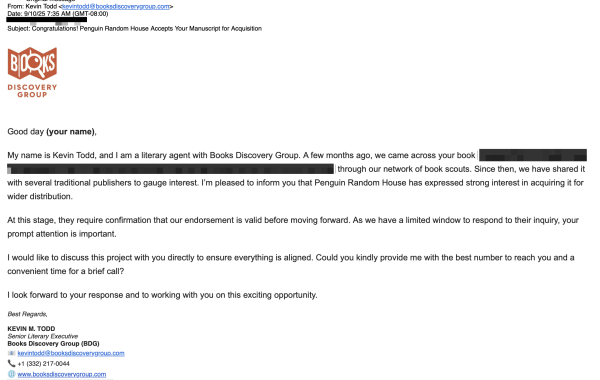
“I’m pleased to inform you that Penguin Random House has expressed a strong interest for wider distribution…”
Sounds pretty good, right? They’re all going to sound good. That’s the entire point. So the question isn’t “does this sound legitimate?” — it’s “can I prove it’s legitimate?”
How to read an AI-written scam email
Once you’ve seen a few of these, the AI fingerprints becomes clear. Here are the tells we look for:
- It’s suspiciously long and over-involved. Real editors are busy. Very few are going to sit down and write you three flowery paragraphs cold.
- The praise is generic and over-the-top. It gushes about “resilience,” “longing,” and “identity” — but never mentions a specific scene, a character, or a single concrete detail only a real reader would catch.
- It loves a string of three. “Endurance, love, and restoration.” “Historical, mythical, and adventure elements.” AI adores rhythmic triplets, and these emails are stuffed with them. (We happen to love writing in threes too — which is exactly why we notice when a machine overdoes it.)
- It’s clearly built from your book’s blurb. Run your own Amazon description through an AI and ask it to “write something that will hook this author,” and you’ll get something that reads remarkably like these emails. It sounds like they read your book. They read your sales copy.
- It treats your book like your only book. Authors with a whole backlist often get notes that act like this one title is their sole, brand-new debut.
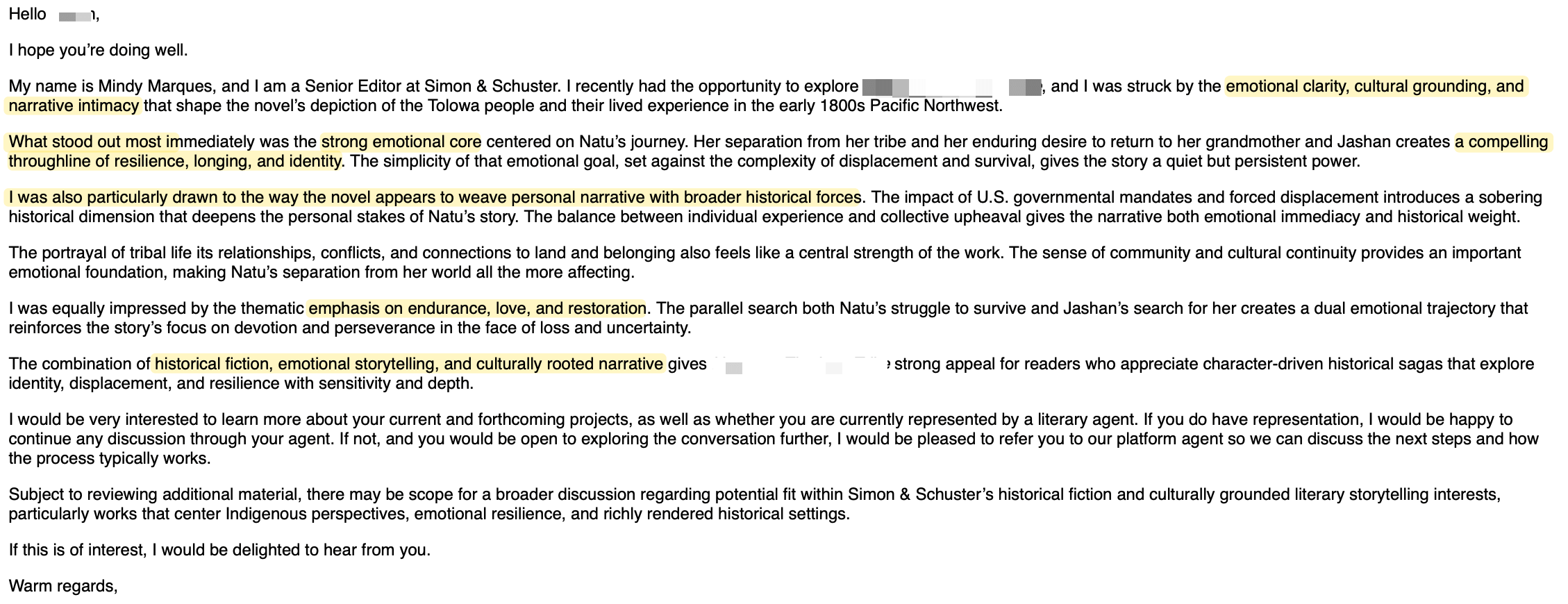
Quick recap: If an unsolicited email is long, flowery, packed with triplets, and reads like it was generated from your back-cover copy — it almost certainly was.
A real example, fully decoded: the fake Simon & Schuster editor
This one is worth slowing down on, because it’s the most convincing kind, and it shows why “it checks out” isn’t good enough.
An author received a note from “Mindy Marques, Senior Editor at Simon & Schuster.” And here’s the unsettling part: if you Google that, Mindy Marques is a real editor at Simon & Schuster. The name is real. The company is real. Most authors would stop right there and feel reassured — which is exactly what the scammer is counting on.
So don’t stop there. Look at the email address:
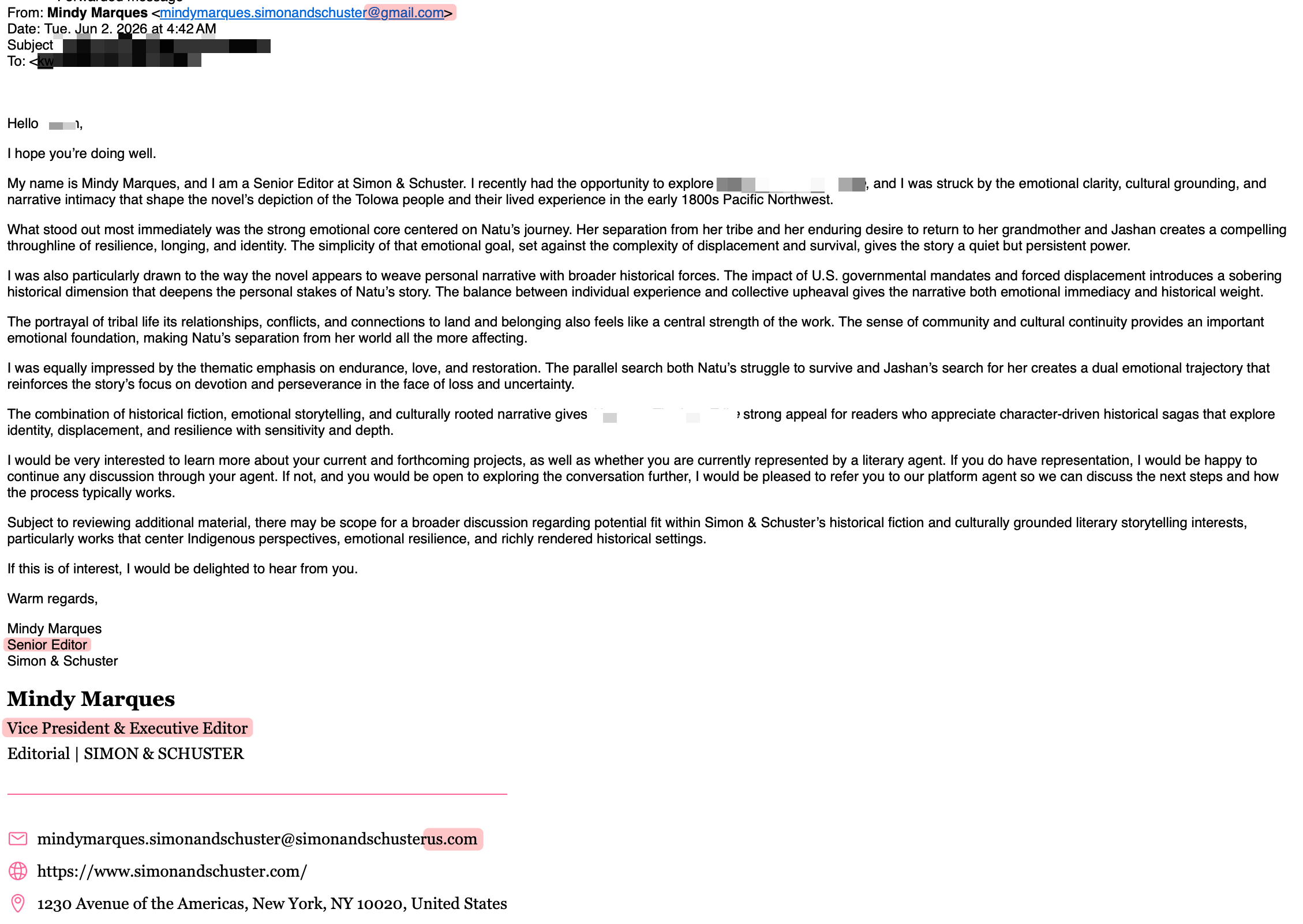
- The message came from a Gmail address with “Simon and Schuster” stuffed into the name. If a “major publisher” is emailing you from Gmail, Hotmail, or Yahoo, it’s a scam. Full stop.
- The reply-to and links pointed to
SimonandSchusterUS.com— which is not the realSimonandSchuster.com. One look-alike word, entirely different owner.
We ran that look-alike domain through a WHOIS lookup (more on that tool in a second). It had been registered weeks earlier, on Squarespace, with a registrant phone number from Nigeria. Simon & Schuster does not build its corporate website on Squarespace, and it does not register a brand-new domain to email you next month.
Notice, too, that the real Simon & Schuster — like Penguin Random House and most major houses — now runs a fraud warning right on its own site. Everyone in this business is trying to wave you off these. You can verify any major-publisher outreach directly through Penguin Random House’s fraud page and similar official channels.
Quick recap: A real name and a real company are not proof. The email address, the actual domain behind the links, and the age of that domain are what give a scam away.
The verification playbook: how to check any agent or publisher
This is the part to bookmark. When something lands that you’re not sure about, run it through these checks — and don’t stop at the first one. The scammers are betting you’ll stop at the first one.
- Google the person and the company. Spell everything exactly as written. Then search again with “scam” or “reviews” added. A legitimate agent or house has a findable history; a scam often has a dead website or nothing at all.
- Scrutinize the email address. Gmail / Hotmail / Yahoo from a “publisher” = scam. Watch for look-alike domains (…US.com, extra words, subtle misspellings).
- Run the domain through WHOIS. It tells you when a domain was registered and where. A “major publisher” on a domain registered three weeks ago, through a website builder, is a giant red flag.
- Check the phone number’s country code. A US publisher with a foreign country code on its registration is worth a hard second look.
- Look them up on Trustpilot. Here’s the trick: scam companies often have only 1-star and 5-star reviews — nothing in between. Click on a glowing 5-star reviewer’s name. If they’ve never reviewed anything else, you’re almost certainly looking at a bot.
- Search the scam-tracking lists. These three organizations track this for a living:
- Writer Beware (run by Victoria Strauss) — extensive, detailed, and frequently updated.
- WritersWeekly (Angela Hoy) — a long-running list of known scammers.
- ALLi’s Self-Publishing Advice Center — including their ratings of the best and worst self-publishing services.
One important caveat: if a company is on a scam list, you know to stay away. If it isn’t, that does not automatically clear it — new scam fronts appear constantly. Absence of evidence isn’t evidence of safety.
Quick recap: Verify independently and verify everything. The information you need is almost always sitting right in the email — you just have to play detective.
The red flags hiding behind every one of these
Step back from any single email, and the same patterns repeat:
- Unsolicited cold contact is the biggest red flag of all. If someone reaches out to you out of the blue, the odds are overwhelming that it’s a scam — whether it arrives as an email, a contact-form message, a DM, or even a phone call.
- The slow drip. They rarely ask for money up front. First comes flattery, then a “conversation about your goals,” then a modest ask — often $500 to $1,000, not $5,000. Small enough to say yes to. And it won’t stop there; there’s always another service to upsell.
- The “trusted name” trick. Scammers love to wear a famous name: “Amazon Publications,” “Amazon Book Publishing,” “Barnes & Noble” something-or-other. The familiar word is doing the lying for them. (We’ve written about one common version of this here: If “Amazon” reaches out to publish your book, it’s probably a scam.)
A reality check that cuts through the flattery: more than four million books were published last year alone. There is no company out there combing through all of them to discover you. Legitimate and traditional publishers don’t cold-email authors — they watch sales numbers and author platforms. The ones doing the cold-emailing are scraping your book’s cover for your name and your contact info, not reading your work.
Quick recap: Cold outreach + flattery + a small, escalating ask + a borrowed famous name = the anatomy of nearly every author scam.
It happens to professionals, too — including us
Don’t think this will never happen to you. Nobody is immune.
A while back, Luminare Press itself was impersonated. We only found out because an author forwarded us an email supposedly from “Caitlin,” one of our team members. “Caitlin” told this author they’d be a perfect fit to publish their memoir and included a link to book a consultation. The link went to a real calendar — just not our calendar. The address on it was in New York; we’re in Eugene, Oregon. The scammers had even set up a look-alike “Luminare Publications” website, populated with stock and scraped photos and fake names.
When Patricia, our founder, contacted the man running it, he was apologetic and disarming: “I’m so sorry, we contracted with an overseas marketing firm and that’s the scheme they came up with.” It was a lie. He scammed her over the phone in real time and walked away with her sympathy. The point of telling you this isn’t to embarrass ourselves — it’s to say plainly: these people are good, and feeling briefly fooled doesn’t make you foolish.
You’ll also find Luminare Press on Writer Beware’s Impersonation List — a list of legitimate companies whose names are being misused by scammers. That’s the company we keep on that list, and it’s exactly why we double down on this education. (You can read our own alert here: Scam Alert: We’ve Been Targeted.)
Already been scammed? Watch out for the retargeting trap
This is the cruelest part, so we want to make sure you hear it.
If you ever do give a scammer money, you become a prime target for a retargeting scam. Sometime later, someone will contact you claiming to be an attorney or recovery agent who can get your money back — for a fee. It follows the same playbook: a warm approach, a “we heard you were scammed,” and then an ask. It’s the same scammers, coming back for a second bite.
We’ll be honest with you, as people who have been targeted this way ourselves (not in publishing, but the tactics are identical): if you’ve been scammed, you are very unlikely to get the money back. What you can do is protect yourself from round two — don’t engage, and report it.
How to report: – Report spam texts and emails through your phone’s or email provider’s built-in “Report Junk / Report Abuse” option. – On a scam website’s WHOIS record, look for the “Report Abuse” link and use it.
The more these get reported, the harder they are to keep running.
Quick recap: No legitimate party cold-contacts you to “recover” scammed money. The recovery offer is the second half of the original scam.
Author FAQ: your publishing-scam questions, answered
Not in our experience. Reputable publishers and agents don’t go fishing through millions of self-published titles to discover you out of nowhere. If you’ve genuinely earned that kind of attention, it’s because your sales and platform got noticed first — not because a “scout” emailed you cold.
It’s more than a red flag — treat it as a scam. Real publishing houses use their own company domains, not free consumer email.
Google the name and company (add “scam” or “reviews”), check the email domain, run the website through WHOIS to see how old it is, look it up on Trustpilot, and search the Writer Beware, WritersWeekly, and ALLi lists. Use several of these, not just one.
Almost certainly not. Scammers love a flattering referral from a recognizable author. If you want to be sure, you can usually contact that author directly through their official website and ask. However, the email itself will usually give it away first.
This is one of the most common pitches precisely because it’s the easiest to want to believe. Run it through the same verification playbook before you feel a thing.
Realistically, no, and you assume all of them are scams. If one truly looks legitimate, put it through every check above before you respond or spend a cent.
You don’t have to figure this out alone
Here’s the mindset that keeps authors safe: throw away 99% of it. And on the rare occasion something genuinely looks legitimate, investigate. Put it through the wringer. The checks in this post take a few minutes and have saved authors thousands of dollars.
If anything ever lands in your inbox that makes you uneasy — especially anything claiming to be from Luminare Press that doesn’t come from a luminarepress.com address — don’t respond to it, and don’t click anything in it. Forward it to us and we’ll tell you straight.
Stay safe out there.
Who is Luminare Press?
15+ years helping independent authors
1,000+ books published
Member of the Alliance of Independent Authors
BBB A+ accredited